If you've ever used a self-propelled treadmill—sometimes called a curved treadmill or non-motorized treadmill—you've probably wondered:
"Why does this feel so much harder than running on a regular treadmill?"
It's a question I hear all the time because many of my conditioning workouts are performed on a self-propelled treadmill.
People often ask:
"Is that thing actually harder than a regular treadmill or running outside? It looks brutal."
The short answer is yes. Research consistently shows that self-propelled treadmills place significantly greater physiological demands on your body than traditional motorized treadmills. Let's look at why.
Although they may look similar, these two types of treadmills create very different running experiences.
A standard treadmill uses a motorized belt that moves at whatever speed you select.
Once you choose your pace, the treadmill does the work of moving the belt while you're responsible for keeping up with it. If you want to run faster or slower, you manually adjust the speed.
This differs from outdoor running, where your pace naturally fluctuates based on terrain, fatigue, and effort level.
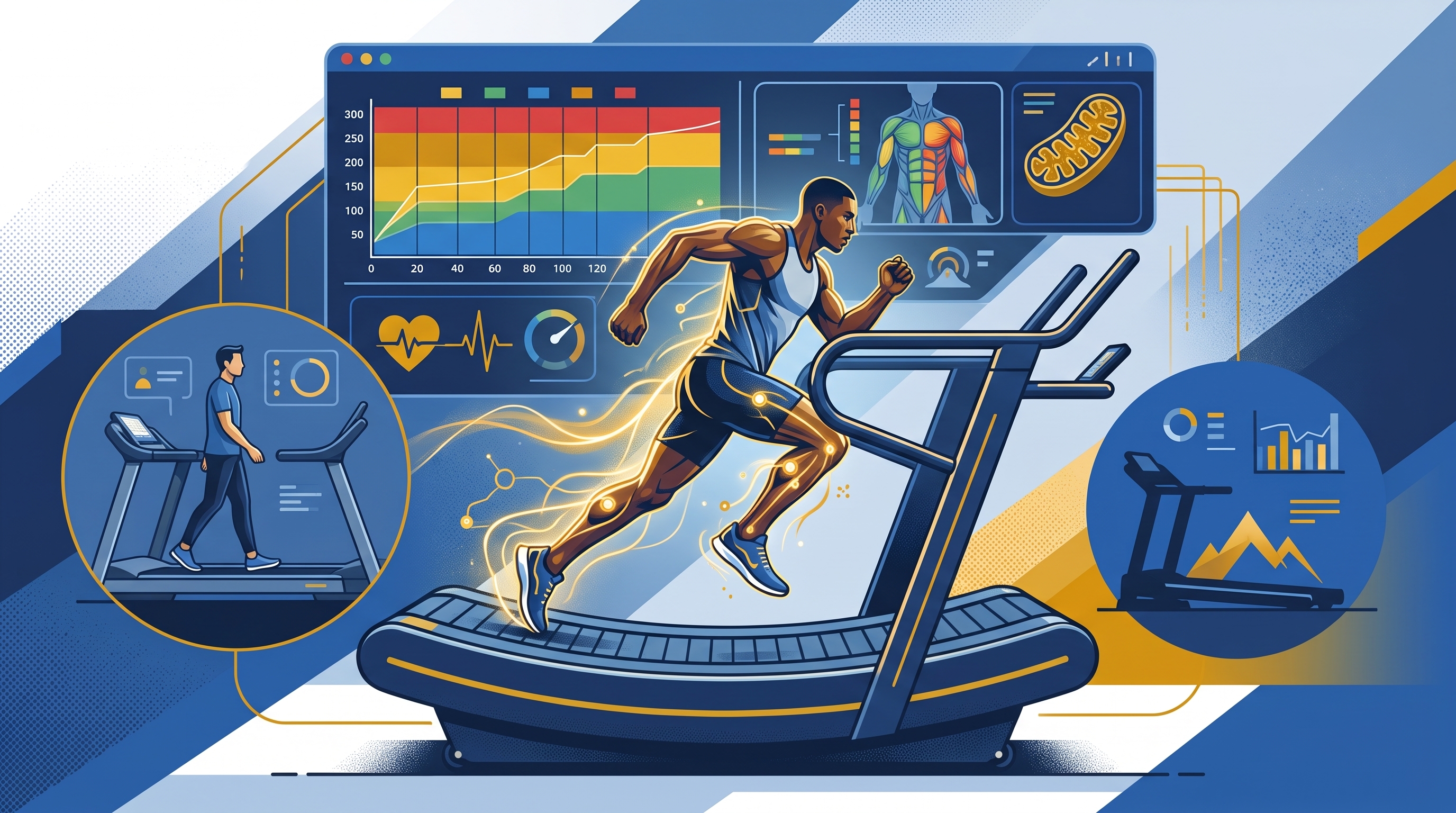
On a self-propelled treadmill, you are the motor.
Instead of the belt pulling you along, every step you take drives the belt forward. The faster you run, the faster the belt moves. Slow down, and the treadmill slows with you.
Most self-propelled treadmills also feature a curved running surface. Running closer to the front increases belt speed, while drifting toward the back naturally slows you down.
This design allows you to self-regulate your pace but also means you're constantly responsible for generating the force needed to keep the treadmill moving.
Several studies have compared self-propelled treadmills with traditional motorized treadmills.
The findings are remarkably consistent.
One study, The Physiological and Perceptual Demands of Running on a Curved Non-Motorized Treadmill and the Implications for Self-Paced Training, evaluated trained runners performing VO₂max and incremental exercise tests on both treadmill types.
Importantly, participants ran at the same speeds on each treadmill, meaning any physiological differences were due to the equipment—not changes in pace.
In other words, participants had to work substantially harder to maintain the exact same speed.
Another study, Increased Physiological Intensity During Walking and Running on a Non-Motorized Curve Treadmill, examined healthy recreational athletes.
Researchers found significantly greater physiological demands during both walking and running on the self-propelled treadmill compared to a traditional treadmill.
Again, maintaining the same pace required considerably more effort.
Additional research comparing 5K performances found that runners completed the distance up to 24% slower on curved self-propelled treadmills while experiencing similar or greater physiological stress.
The takeaway?
If your pace drops on a self-propelled treadmill, it doesn't necessarily mean your fitness has declined. The equipment itself is more demanding.
Several factors contribute to the increased workload.
Unlike a motorized treadmill, nothing happens unless you generate force.
Every stride must both propel your body forward and move the treadmill belt underneath you.
That additional mechanical work increases energy expenditure.
Most self-propelled treadmills are built with a curved running deck.
Although the incline is subtle, you're effectively running against resistance throughout every stride, increasing muscular and cardiovascular demands.
Running economy refers to how much energy it takes to maintain a given pace.
Research consistently shows that self-propelled treadmills decrease running economy, meaning your body must expend more energy to run at the same speed.
Unlike a motorized treadmill that maintains your pace for you, a self-propelled treadmill requires continuous adjustments.
You're constantly managing your position on the belt while generating enough force to maintain speed, adding both physical and mental demands.
Your pace on a self-propelled treadmill will almost certainly be slower than your pace on a traditional treadmill or outdoors.
That's completely normal.
Trying to force your usual pace often leads to working much harder than intended.
Rather than chasing outdoor or motorized treadmill paces, use:
Match your effort—not your speed.
If today's workout calls for Zone 2 or moderate intensity, simply slow the pace until your effort matches the intended training stimulus.
Self-propelled treadmills are excellent for:
Self-propelled treadmills aren't just psychologically harder—they're physiologically more demanding.
Research shows they increase oxygen consumption, heart rate, perceived effort, and calorie expenditure while reducing running economy compared with traditional motorized treadmills.
For most runners, that translates to roughly 30% greater physiological demand at the same running speed.
So if your pace is slower on a self-propelled treadmill, don't assume you're out of shape.
Adjust your expectations, train based on effort instead of pace, and use these treadmills as another valuable tool in your conditioning program.
Sometimes the hardest workouts aren't harder because you're less fit—they're harder because the equipment asks more of you.
Request your initial evaluation today, or get to know the clinical team behind our evidence-based care.