
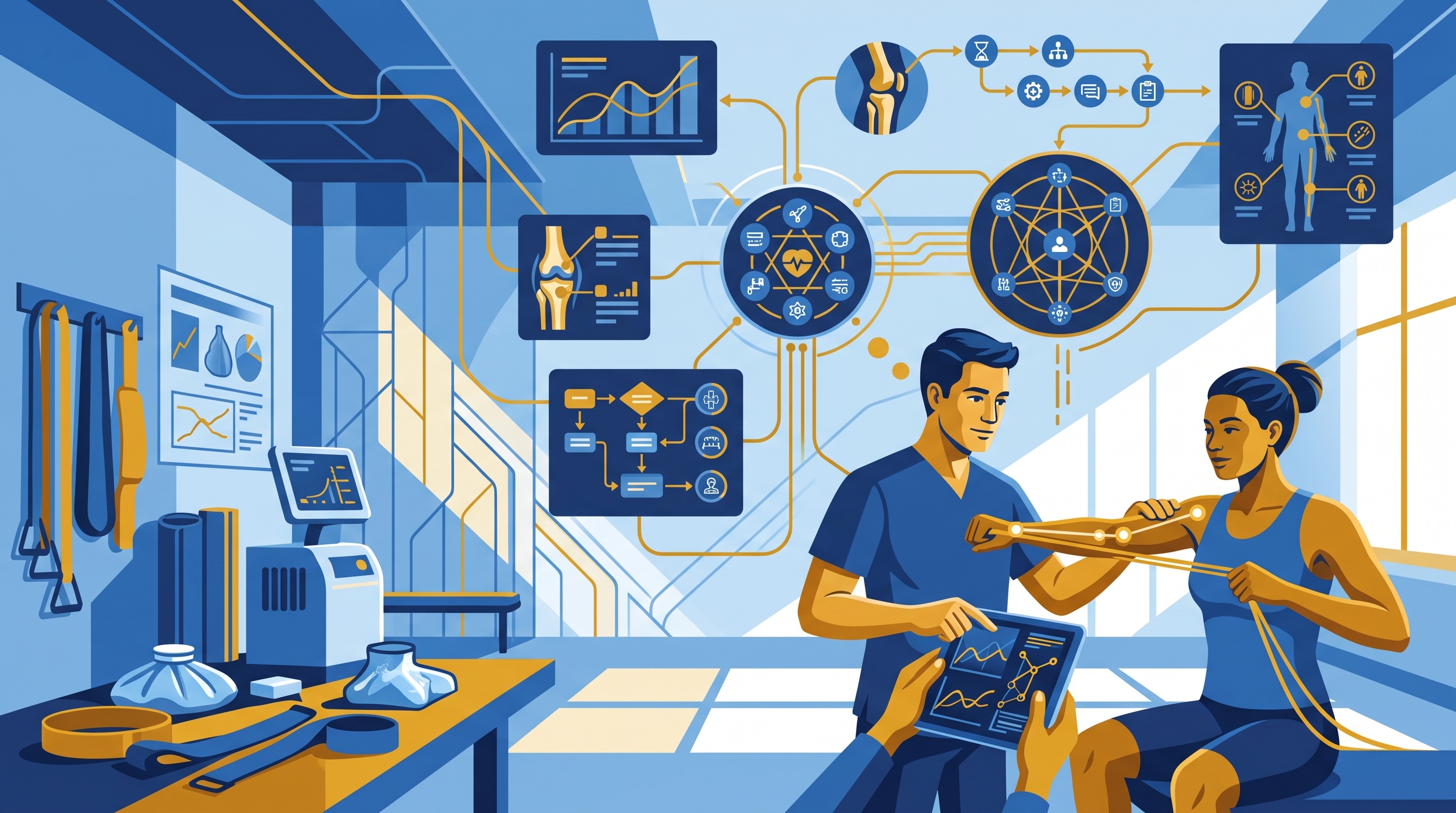
One of the most persistent misunderstandings about physical therapy is that it is simply a collection of treatments: exercises, manual therapy, electrical stimulation, taping, blood flow restriction training, scraping, and so on. Physical therapy is none of those things by itself. Those are tools. A physical therapist may use some of them, all of them, or none of them.
At its core, physical therapy is a profession built on clinical reasoning, critical thinking, and decision-making. The most important skill of a physical therapist isn't knowing how to perform an exercise or operate a piece of equipment. It's knowing whether an intervention is appropriate for a particular patient, at a particular point in their condition—and why.
When a patient enters a physical therapy clinic with pain, weakness, or difficulty moving, the therapist doesn't simply select a treatment from a menu. First, they have to determine what is happening. That means gathering information, identifying patterns, forming hypotheses, testing those hypotheses through examination, interpreting the findings, and continuously updating their clinical impression.
A physical therapist may ask:
These are decision-making questions. The physical therapist is constantly comparing the patient's presentation with expected clinical patterns and using new information to determine what should happen next.
A modality is a treatment tool or physical agent. Neuromuscular electrical stimulation is a modality. Manual therapy is a modality. Exercise can be a treatment tool. None of these independently evaluates a patient, establishes a differential diagnosis, recognizes a red flag, determines prognosis, or decides whether a patient needs imaging or surgery. The clinician does those things.
This distinction matters because patients sometimes equate physical therapy with whatever treatment they received during a previous rehabilitation experience.
A scalpel is a tool used by a surgeon. In the same way, exercises, manual techniques, and physical agents are tools used by physical therapists. The professional expertise lies in the examination, interpretation, clinical reasoning, treatment selection, and reassessment surrounding those tools.
A highly skilled physical therapist doesn't begin with: "What treatment should I give?" The better question is: "What is most likely happening, and what information do I need to make the best decision?"
The therapist first performs an examination and develops a working clinical hypothesis. Treatment is then selected based on the findings, and the patient is reassessed.If the patient improves as expected, that response provides additional clinical information. If they don't improve—or develop unexpected symptoms—the therapist must reconsider the working diagnosis and treatment plan.
This makes physical therapy an iterative clinical decision-making process: What did I expect to happen? What actually happened? What does that tell me? What should I do differently? That is clinical reasoning.
Health care rarely provides perfect information. A patient may have significant pain without a definitive imaging finding. An MRI may show several abnormalities without making it clear which one is responsible for the patient's symptoms. Symptoms may also change from day to day.
Physical therapists are trained to work within that uncertainty. They combine the patient's history, physical examination, movement assessment, functional testing, research evidence, and response to treatment to continually refine their clinical judgment.
This is why two patients with the same anatomical finding may receive completely different treatment plans. Consider a rotator cuff tear. That finding doesn't automatically dictate one universal treatment. The therapist must consider the patient's age, activity level, symptoms, strength, range of motion, functional goals, irritability, mechanism of injury, neurological status, medical history, expectations, and response to loading.
The diagnosis informs the treatment. The individual patient determines the decisions.
The defining expertise of physical therapy is movement and function. Physical therapists study how the human body moves—and what happens when movement is impaired. This requires knowledge of anatomy, physiology, biomechanics, neuroscience, pathology, exercise physiology, motor control, tissue loading, pain science, and functional performance.
But knowledge alone isn't enough. The therapist must integrate that information in real time.A patient may have limited shoulder motion. The therapist has to determine why. Is it caused by pain? Joint stiffness? Muscle weakness? Fear of movement? A neurological problem? A cervical spine disorder? A tendon-related condition? Multiple factors? The answer changes the treatment.
This is why physical therapy should be understood as a clinical profession centered on movement and function, rather than as a collection of procedures.
Exercise is one of the most powerful tools available to physical therapists. But prescribing exercise isn't the same thing as being a physical therapist. Anyone can tell someone to strengthen their quadriceps or stretch their hamstrings.
The expertise is determining:
That is the difference between giving someone exercises and providing physical therapy. A physical therapist uses exercise as part of a broader clinical decision-making process.
Understanding physical therapy as a reasoning profession changes how patients should think about seeking care. You don't necessarily need to arrive at a physical therapist's office with a diagnosis already in hand. The PT can evaluate your presentation, determine whether it appears appropriate for physical therapy, develop a clinical diagnosis within their scope of practice, establish a prognosis, and create an appropriate plan of care.
And if the presentation doesn't fit a condition appropriate for physical therapy, the therapist's responsibility isn't to force you into a treatment plan. It's to recognize that something may require additional evaluation and make an appropriate referral. The ability to say "this isn't behaving like the condition I expected" is an essential part of clinical competence.
The public perception of physical therapy often focuses on what the therapist does to the patient. A better understanding focuses on what the therapist thinks about the patient.
The important questions are:
The tools matter. But the clinical reasoning behind when, how, and why those tools are used is what makes physical therapy a clinical profession.
The American Board of Physical Therapy Specialties (ABPTS) offers board certification in 10 specialty areas. A PT who earns the Orthopaedic Clinical Specialist (OCS) credential has demonstrated advanced knowledge and clinical experience in treating musculoskeletal conditions.
After completing a DPT, some PTs pursue additional advanced training:
Orthopaedic care is very common in physical therapy, but advanced credentials are much less common. More than 25,000 PTs are OCS-certified, while only a small fraction of PTs—likely less than 1%—have completed an advanced OMPT fellowship and earned the FAAOMPT designation.
Request your initial evaluation today, or get to know the clinical team behind our evidence-based care.